


What is injection overmolding?
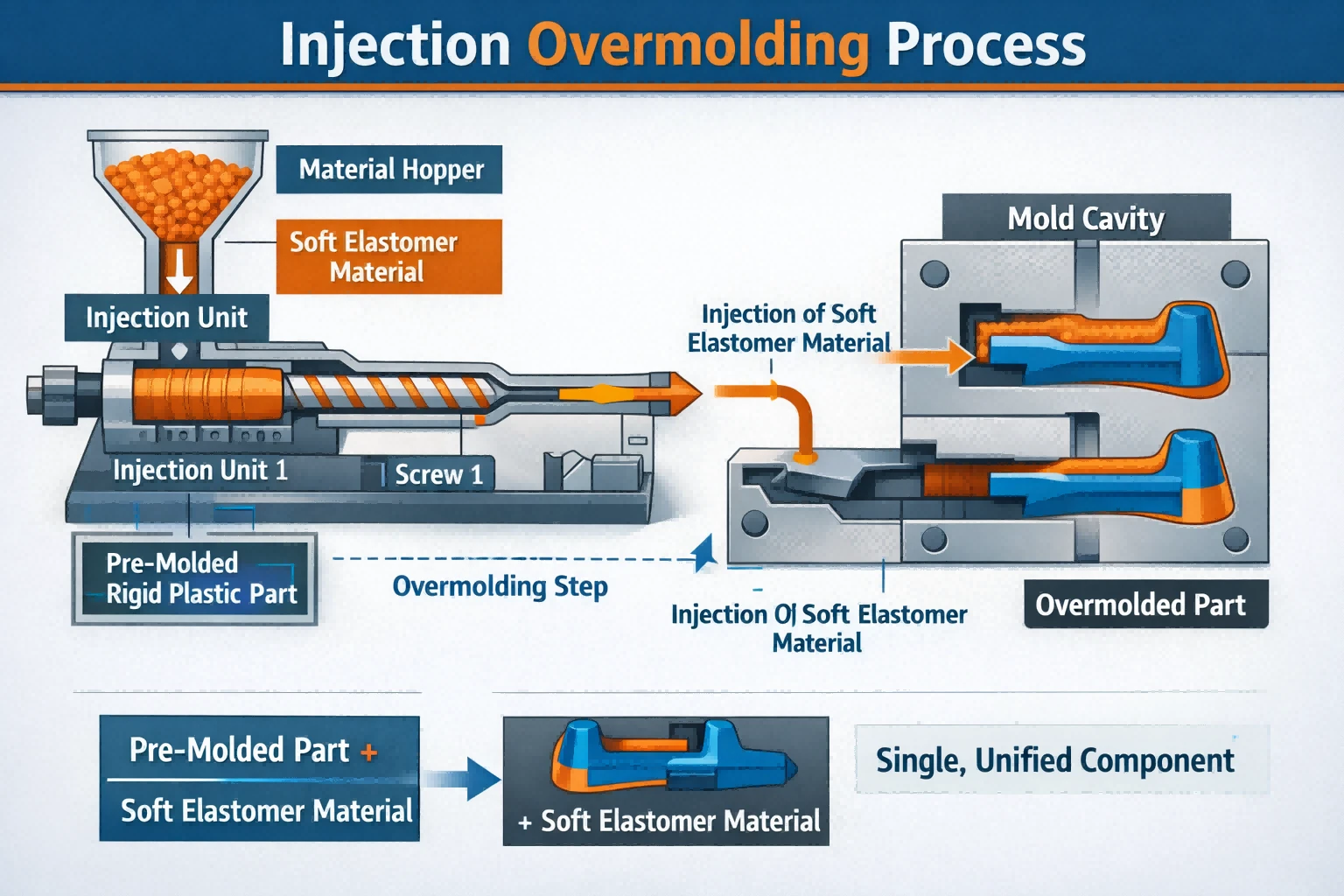
Overmolding is an injection molding process used to mold one plastic (commonly a rubber-like plastic called TPE) over top of another component (substrate). The substrate is usually an injection-molded plastic part, but it could also be made from various other materials.
Overmolding is sometimes referred to as two-shot molding because it is a two-step process.
Overmolding enables manufacturers to create parts from multiple materials using a manual two-stage process for small production runs or an automated two-stage process for large production runs.
Materials Commonly Used in Overmolding
Overmolding can be used with a wide range of materials, including:
|
ABS(AcrylonitrileButadieneStyrene) |
PMMA(Acrylic) |
|
HDPE (High-density Polyethylene) |
POM (Polyoxymethylene) |
|
PEEK (Polyether Ether Ketone) |
PP (Polypropylene) |
|
Nylon (Polyamide) |
SI (Silicone) |
|
PC (Polycarbonate) |
TPE (Thermoplastic Elastomers) |
|
PE (Polyethylene) |
TPU (Thermoplastic Polyurethane) |
|
PEI (Polyetherimide) |
TPR (Thermoplastic Rubber) |
|
PBTR (Polybutylene Terephthalate) |
|
When selecting material, both the substrate and the overmold material should be considered. For example, two TPEs may feel the same in terms of softness, but one may not adhere properly to a polypropylene substrate. Key factors to consider include:
Bonding – Some Materials will bond together when overmolded, and others will not. A complete bond is the ideal situation, although it is not always necessary. If the materials can't bond together or don't need to, mechanical features like undercuts and indents can be designed to ensure a long-lasting connection.
Temperature – Since you are molding plastic over plastic, the substrate must not deform under the heat and pressure of the injection molding process.
How does injection overmolding work?
The process begins with the molding of the initial part or substrate using standard injection molding techniques. This part can be made from various materials, including metals and rigid plastics. Once the substrate is molded, it is placed into a second mold cavity designed specifically for the overmold material, either manually or with automated systems. The overmold material, typically a softer thermoplastic elastomer, is then injected into the mold cavity around the substrate. This material bonds with the substrate, either mechanically or chemically, depending on the materials used. Finally, the completed part is allowed to cool and solidify in the mold before being ejected, resulting in a composite part that combines the properties of both materials.
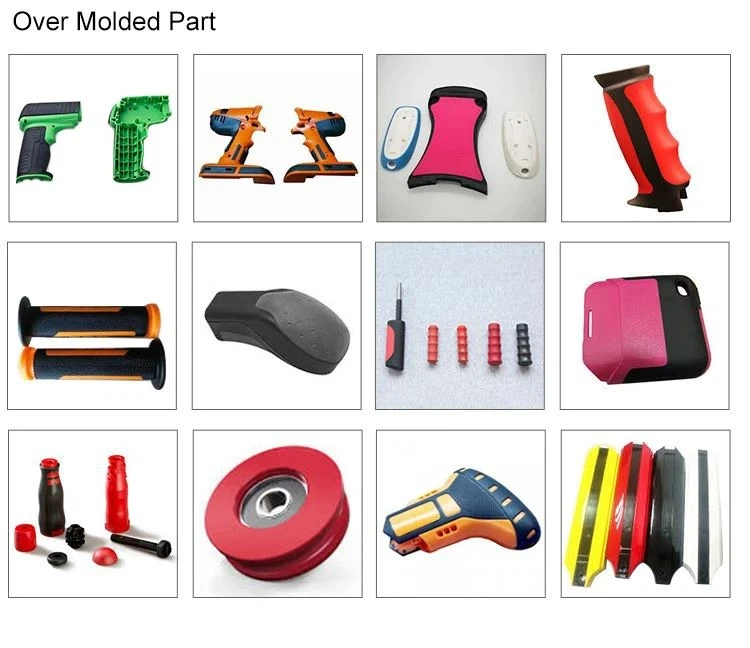
What's Possible with injection overmolding?
- Add a soft-touch exterior to products
- Enhance grip or "feel"
- Provide a stylish appearance that's attractive to consumers
- Reduce shock and vibration
- Dampen sound
- Provide electrical insulation
- Improve chemical/UV resistance
- Increase product longevity
How to Know If Overmolding Is Better for Your Project?
1.Your part's surface needs to have different electrical or thermal properties.
2.You want to increase your part's shock absorption or vibration damping.
3.Your finished design consists of multiple layers, materials (limited to those listed above), and/or colors.
4.You will be manufacturing both the substrate and secondary layer.
5.Your completed piece will not need to be taken apart or disassembled.
Benefits of Injection Overmolding
ENHANCED PRODUCTDURABILITY
Overmolding creates a strong bond between different materials,resulting in a composite part that is more robust and resilient than components produced by other methods.
COST EFFICIENCY
Plastic injection overmolding integrates multiple components into a single overmolded part. This eliminates the need for additional assembly steps, reducing labor costs and production time.
VERSATILITY
This process can be applied to various materials and products,making it suitable for diverse applications across multiple industries. This flexibility allows manufacturers to innovate and create products that meet specific performance and design requirements.
INCREASED PRODUCTFUNCTIONALITY
Overmolding can enhance a product's functionality by combining different materials with complementary properties.
DESIGN FLEXIBILITY
The overmolding process enables manufacturers to produce complex geometries and intricate designs that would be difficult or impossible to achieve with other manufacturing methods.
Safety
Overmolding improves gripping areas, more shock resistant, and eliminates rough edges for comfort and ease of use.
Aesthetics
Overmolding offers more pleasing shapes with more style and color choices.
Key factors to optimize the overmolding process
Material
Choosing the appropriate materials is fundamental to the success of the overmolding process. The primary and secondary materials must have similar thermal properties and chemical compatibility to ensure a strong bond.
Mold Design
The mold must be engineered to fit the primary and secondary materials accurately. This involves designing the core and cavity to match the part's geometry and incorporating cooling channels to control temperature and reduce cycle times.
Process Parameters
Optimizing process parameters such as injection pressure, temperature, and cycle time is essential for producing consistent, high-quality, overmolded parts. These must be carefully controlled and monitored to prevent defects such as warping, incomplete filling, or material separation.
Bonding Techniques
Proper bonding between the overmold and the substrate is essential for product integrity. Surface preparation is often required to increase the substrate's surface energy, improving adhesion.
Insert Placement
Inserts must be accurately positioned within the mold cavity to ensure proper encapsulation and alignment. This often requires specialized fixtures or automated systems to maintain precise positioning during molding.
Venting and Cooling
Proper venting prevents air and gases from being trapped, which can cause defects. Cooling systems must ensure uniform temperature distribution to avoid issues such as thermal gradients or uneven shrinkage, which can impact part quality.
Quality Control
Rigorous quality control measures ensure that overmolded parts meet the required specifications and performance standards.
Applications of injection overmolding
Automotive Components
In the automotive industry, overmolding is widely used to eliminate the need for adhesives in assembling components. Typical applications include engine parts, dashboards, door locks, and other plastic-over-molded components.
Medical Devices
Overmolding simplifies the production of medical devices, even highly sophisticated ones. Examples include defibrillators, insulin pens, infusion pumps, and blood pressure monitors.
Protective Casings
Overmolding is also an effective method for producing protective casings for electrical and electronic devices. It enhances functionality while adding aesthetics and reliability. Over-molded casings provide users with better grip and handling, making products safer and more comfortable to use.
Hot Tags: injection overmolding, China injection overmolding manufacturers, suppliers, factory, overmolds, plastic overmolding process, tpe overmold, overmolding injection molding process, overmolding and insert molding, overmolding injection molding


