


Low-volume injection molding is a manufacturing process that has gained significant traction in recent years. It's defined by its ability to efficiently produce small to moderate quantities of parts, typically ranging from a few hundred to a few thousand units. The significance of this approach lies in its capacity to cater to the evolving needs of modern industries. Unlike traditional high-volume injection molding, which is geared toward mass production, low-volume molding offers a versatile and cost-effective solution for businesses with diverse requirements.
The significance of low-volume injection molding is multifaceted. It empowers businesses with the ability to swiftly respond to market trends, tailor products to specific customer segments, and iterate designs without incurring exorbitant tooling costs. This level of flexibility is instrumental in reducing time-to-market, accommodating design modifications, and catering to niche markets that demand specialised products.

What is low volume plastic injection molding?
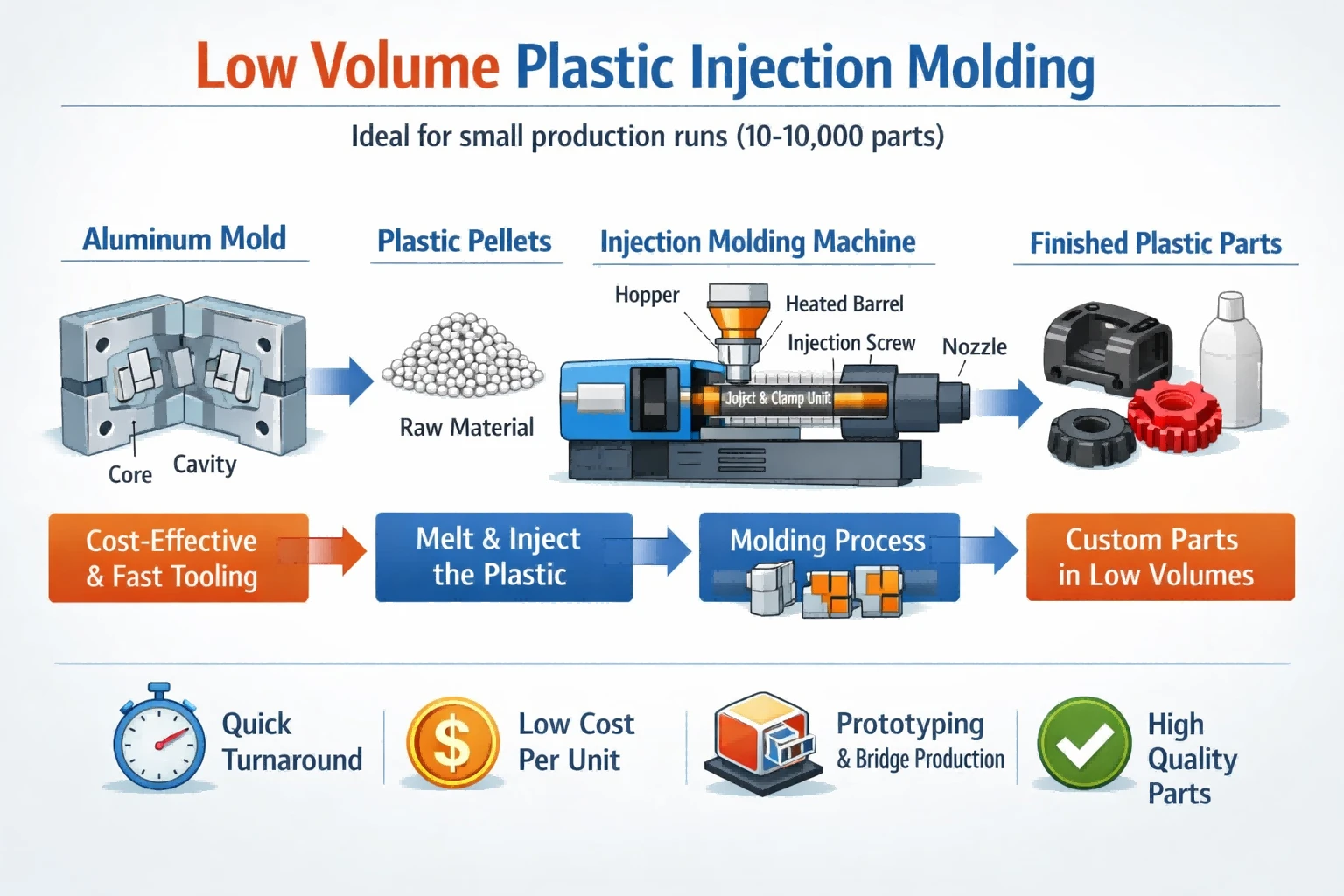
Low volume injection molding refers to the production of small batches (typically less than 1000 pieces) of plastic parts. It's a manufacturing process that bridges the gap between rapid prototyping and large-scale production, offering a streamlined and cost-effective solution for producing limited quantities of parts. This approach is particularly valuable in scenarios where the demand doesn't justify the expenses associated with traditional mass production.
Low-volume products are typically produced as prototypes or functional components, such as those found in medical devices or automotive parts.
The Process of Low Volume Plastic Molding
The low volume plastic molding process includes five basic steps explained below:
Tooling and Mold Design
The first step is the identification of the final plastic parts specifications and choosing the right materials. This will aid in the design of the mold. Metals are suitable for making injection molds with aluminum being the most popular.
Prototyping
This involves using 3D printing to create a prototype of injection molds also known as 3D printed molds. Engineers can make use of the mold normally after checking for flaws in design and functionality and correcting the errors. The mold is then improved using manufacturing processes such as 3D printing or CNC machining.
Setting Up the Injection Molding Machine
Components such as an ejector system are installed into the mold before being loaded on an injection molding machine. The engineer then configures the machine temperature, pressure, and injection speed and conducts a test run to check the production run quality.
Injection Molding Process
The injection molding process is divided into four sub-steps explained below:
Clamping
This involves using a clamping system that can generate a clamping force that holds the mold in place, closing the gap between the mold halves. The clamping force should be equal to the injection force to prevent disruptive movement and should be lower in 3D printed injection molds that are protected by a metal frame.
Injection
This depends on the type of machine but involves the transfer of the molten plastic to the injection barrel and subsequent injection to the mold.
Cooling
After you inject molten material into the plastic injection mold, the molten plastic cools and solidifies. The cooling/solidification time depends on the type of mold taking longer to cool due to a slower thermal transfer occurring in plastic than metal. In such a case, cooling is improved by using compressed air or interchangeable stacks.
Ejection
Ejection of low volume plastic parts can be manual or via the use of ejector pins. In the latter, the clamping plate moves backward and the mold halves open. Afterward, the ejector pins push out the final part.
Quality Control and Post-Processing
Quality control involves inspecting low-volume plastic parts for any defect and ensuring they meet quality standards. Afterward, trim the molded parts and use secondary surface finishing operations.
Materials Available for Low-Volume Injection Molding
Low-volume injection molding is a versatile manufacturing method suitable for producing small quantities of plastic or metal parts. This process is particularly attractive for prototypes, custom components, and limited production runs due to its cost-effectiveness and efficiency. To successfully carry out low-volume injection molding, various materials are available:
|
Plastic |
Characteristics |
|
Acetal (POM) |
Excellent rigidity and thermal stability with low water absorption and good chemical resistance. |
|
Acrylic (PMMA) |
Strong, lightweight, shatter-resistant, optically clear, and UV and weather-resistant. |
|
Acrylonitrile Butadiene Styrene (ABS) |
Strong and impact-resistant, even at low temperatures. |
|
Nylon (PA) |
Tough with high heat resistance, high abrasion resistance, and good fatigue resistance. |
|
Polybutylene Terephthalate (PBT) |
Resistant to creep and used in parts with thin cross-sections. |
|
Polycarbonate (PC) |
Strong, lightweight, and naturally transparent, with stable properties over a wide temperature range. |
|
Polyether Ether Ketone (PEEK) |
Excellent mechanical properties and resistance to chemicals and thermal degradation. |
|
Polyetherimide (PEI) |
Combines stiffness and stability with low flammability and low smoke production. |
|
Polyethylene (PE) |
Generally used for indoor applications. Chemically resistant. Includes high and low-density polymer materials. |
|
Polyphenylsulfone (PPSU) |
High toughness, high flexural and tensile strength, and good resistance to chemicals and heat. |
|
Polypropylene (PP) |
Good chemical resistance and won't degrade when exposed to moisture or water. |
|
Polystyrene (PS) |
Lightweight, relatively inexpensive, and resistant to moisture and bacterial growth. |
|
Thermoplastic Elastomer (TPE) |
Processed like plastic but has the properties and performance of rubber. |
|
Thermoplastic Polyurethane (TPU) |
Rubber-like elasticity with good load-bearing capabilities. |
Advantages of Low-Volume Injection Molding
1. Cost-Effectiveness for Small Production Runs
Traditional injection molding often comes with significant upfront tooling costs, which can make it financially challenging for small production runs. Low-volume injection molding, on the other hand, reduces these initial expenses, making it feasible and cost-effective to manufacture smaller quantities of parts. This is especially valuable for businesses that want to test the market with a limited batch of products or cater to niche customer segments without breaking the bank.
2. Faster Time-to-Market
In the rapidly evolving business landscape, the speed at which your product reaches the market can be a game-changer. Low-volume injection molding provides quicker lead times in comparison to conventional techniques. The reduced setup time and simplified tooling process mean that you can move from design to finished parts in a fraction of the time, enabling you to seize market opportunities before they pass by.
3. Iterative Design Improvements
Product development is an iterative process, and the ability to refine your design based on real-world feedback is crucial. Low-volume injection molding provides the flexibility to produce multiple iterations of your product without the prohibitive costs associated with traditional tooling changes. This iterative methodology empowers you to refine your design, optimize functionality, and elevate quality prior to committing to full-scale production.
4. Reduced Material Waste
Wasting materials isn't just detrimental to the environment; it's also costly for your business. With low-volume injection molding, you produce only the quantity of parts you need, minimising excess inventory and material waste. This sustainability aspect not only aligns with environmentally conscious practises but also contributes to a more efficient and cost-effective production process.
5. Customisation and Niche Markets
The modern consumer landscape craves personalised and tailored products. Low-volume injection molding caters excellently to this demand by allowing you to create custom products, specialised components, and unique designs. This level of customisation is invaluable for tapping into niche markets and meeting the diverse preferences of consumers who seek products that stand out from the crowd.
6. Risk Mitigation
Launching a new product involves inherent risks, including market acceptance and unforeseen design flaws. Low-volume injection molding serves as a risk mitigation strategy. By producing a limited quantity of parts, you can test the waters, gauge customer response, and identify any potential issues before scaling up. This approach minimises potential losses associated with producing large quantities of faulty products.
Our Low-Volume Capabilities
1. Prototyping and Pre-Production
From design optimization to functional testing, we produce parts that help you refine your product before committing to full-scale production.
2. Material Versatility
Our expertise with a wide range of engineering plastics - including PC, PA, PMMA, POM, PPO, PBT, PC/ABS, and TPU - means we can tailor material properties to meet your project's requirements.
3. Custom Mold Design
Our experienced engineering team designs and builds molds optimized for small-batch runs, balancing cost, lead time, and part quality.
4. Flexible Production Scheduling
We accommodate short production runs, making it easy to produce a limited quantity of parts for special orders, seasonal demands, or pilot programs.
Hot Tags: low volume plastic injection molding, China low volume plastic injection molding manufacturers, suppliers, factory, peek plastic injection molding, 3k injection molding, Multi Shot Molding, short shot injection molding, plastic molding development, plastic mold injection


